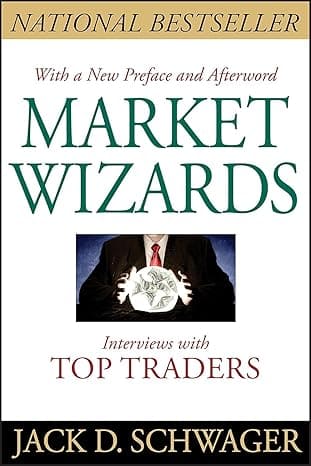
Jack D. Schwager shares actionable insights and psychological strategies from world-class traders to help you master market discipline, manage risk, and discover your personal trading edge.
Key Takeaways
- Focus on risk management and capital preservation before looking at potential profits.
- Trade a methodology that strictly aligns with your personal psychology and risk tolerance.
- Cut losses quickly and unemotionally; taking small losses is a cost of staying in the game.
- Mastering trading psychology and discipline is far more critical than finding a perfect indicator.
About Jack D. Schwager
Jack D. Schwager is a renowned financial author, industry expert, and hedge fund industry leader. He is best known for his landmark Market Wizards series, in which he interviews the world's most successful traders to extract timeless market principles. Schwager has written extensively on futures trading, technical analysis, and hedge fund evaluation.
If you have ever wondered what truly separates elite market performers from those who consistently lose capital, Market Wizards by Jack D. Schwager provides direct, unvarnished answers. I read this timeless classic so you don't have to, dissecting its core interviews to extract actionable lessons on risk management, strategy development, and psychological resilience.
This book isn't a textbook filled with rigid formulas or deterministic market predictions. Instead, it offers raw, candid conversations with legendary figures who transformed small accounts into fortunes or posted unprecedented annual returns. Whether you trade equities, futures, or foreign exchange, understanding how these professionals operate under pressure is the fastest way to refine your own edge.
Key Lessons from Market Wizards Interviews with Top Traders
1. Absolute Commitment to Risk Management
The single unifying trait across every top trader interviewed by Schwager is an obsessive focus on risk control. Amateur traders focus almost exclusively on how much money they can make on a trade, whereas master traders calculate exactly how much they can afford to lose before ever placing an order.
2. Personal Alignment with Strategy
There is no single "holy grail" methodology. Some traders in the book rely purely on technical analysis and chart patterns, while others use fundamental macro drivers or systematic trend-following. Success stems from choosing a methodology that aligns perfectly with your individual personality, risk tolerance, and psychological strengths.
3. Strict Emotional Discipline and Adaptability
Losing trades are an inevitable cost of doing business. Elite traders view losses objectively as market feedback rather than personal failures. They possess the emotional control to cut losses quickly, let winning trades run, and adapt instantly when market conditions invalidate their initial thesis.
Market Wizards Interviews with Top Traders Chapter Breakdown
Part I: Futures and Currencies
This section features legendary macro traders like Michael Marcus, Bruce Kovner, and Paul Tudor Jones. Key insights include:
- Michael Marcus: Emphasizes the importance of waiting for high-probability setups where technicals, fundamentals, and market tone all align.
- Bruce Kovner: Highlights the critical role of position sizing, advising traders to place stop-losses at logical technical points rather than arbitrary dollar amounts, sizing the trade down accordingly.
- Paul Tudor Jones: Shares his rule of defensive trading—focusing on capital preservation first, aggressively cutting positions that aren't working, and maintaining a high risk-to-reward ratio.
Part II: Equities and Stock Trading
Focusing on stock market legends like Ed Seykota, Richard Dennis, and William O'Neil, this section delves into trend-following, rules-based systems, and growth stock selection:
- Ed Seykota: A pioneer in computer-directed trend following who stresses that market success is 85% psychology and discipline, and that everyone gets what they want out of the market.
- Richard Dennis: The brain behind the famous Turtle Traders experiment proves that successful trading can be taught via systematic, rule-based risk management.
- William O'Neil: Founder of Investor's Business Daily details his CAN SLIM strategy, proving that buying stocks making new high prices often yields much larger gains than bargain hunting.
Part III: Psychology and Mindset
The closing sections synthesize the mental framework required for sustained market longevity. Schwager highlights Dr. Van K. Tharp's research on trader psychology, demonstrating how personal biases, fear, and greed systematically destroy trading performance if left unmonitored.
Critique: Where Market Wizards Shows Its Age
While the psychological principles and risk control rules in Market Wizards are immortal, readers must evaluate the execution details through a modern lens. Many of the interviews took place during an era dominated by pit trading, physical order flow, and slower market mechanics. Today's markets feature high-frequency algorithms, zero-commission retail execution, and immediate global information dissemination.
Furthermore, because the book presents diverse, often conflicting viewpoints—such as pure fundamental traders scoffing at charts while trend-followers ignore news entirely—novice traders might feel overwhelmed by the lack of a single, step-by-step trading system. The book demands that you do the heavy lifting of synthesizing these perspectives into a style that fits you.
To dive deeper into the specific entry rules, position-sizing equations, and psychological exercises referenced by these legendary figures, check out the key takeaways and resources highlighted in the sidebar.
Notable Quotes
“"Win or lose, everybody gets what they want out of the market. Some people seem to like to lose, so they win by losing money."”
“"Elements of good trading are: (1) cutting losses, (2) cutting losses, and (3) cutting losses. If you can follow these three rules, you may have a chance."”
“"I'm always thinking about losing money rather than making money. Don't focus on making money, focus on protecting what you have."”
Who Should Read This
Intermediate traders and investors who have a basic understanding of market mechanics but struggle with emotional consistency
Who Should Skip This
Experienced systematic traders who already have a validated, fully automated trading strategy and advanced risk controls.
How It Compares
This guide offers a concise overview of technical mechanics and psychology similar to foundational texts in technical analysis, but focuses more on high-level practical takeaways than deep statistical backtesting.
Final Verdict
A solid, grounded overview for market participants who need to realign their trading with core principles of risk and structural price analysis. I appreciated the practical focus on position sizing, though traders should remember that live market slippage often complicates theoretical chart setups.