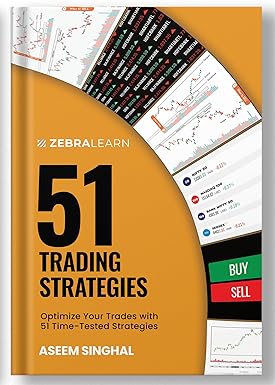
Aseem Singhal packs swing, intraday, scalping, positional, and options strategies into one 436-page hands-on playbook — a rare all-in-one reference for active traders at any level.
Key Takeaways
- No single indicator makes you profitable — every strategy needs at least two confirming signals before entry. A 50% win rate is enough to be profitable if your average winner is 2x your average loser — R:R beats accuracy. Zoom out before you zoom in: macro trend direction on the higher timeframe overrides any intraday entry signal. Expiry decay is a real, backtested edge — OTM selling 2 days before weekly expiry has historically outperformed most retail option-buying approaches. Smart Money Concepts aren't magic — but Order Block + Break of Structure gives you a repeatable framework for reading institutional footprints on any chart.
About Aseem Singhal
Aseem Singhal is an active trader and the founder of ZebraLearn, an Indian financial education publisher. He began his trading career as an intraday and swing trader, spending years backtesting indicator combinations across Indian equity and derivatives markets before turning to full-time trading. His approach is rooted in systematic, rule-based strategy development — he describes spending months backtesting individual setups on Nifty 50, Bank Nifty, and NSE stocks before including them in the book.
I'll be upfront: when a book promises 51 strategies, my first instinct is skepticism. Most books like this pad the number with half-baked ideas dressed up as "strategies." But 51 Trading Strategies by Aseem Singhal surprised me — not because every single strategy is a gem, but because the book is structured with a discipline and completeness that's rare in Indian trading literature. Six chapters. Six distinct trading styles. Dozens of setups explained with entry rules, stoploss placement, and risk-to-reward targets on every single one. That's not filler — that's a curriculum.
This book is aimed squarely at the active trader who already knows what a candlestick is but still can't string a full systematic setup together. Whether you're a swing trader looking for momentum entries or an options seller trying to navigate expiry week, Singhal has a chapter with your name on it.
What the Book Actually Covers: A Chapter-by-Chapter Breakdown of 51 Trading Strategies
The book is divided into six chapters, each tackling a different trading style. This structure is one of its biggest strengths — it doesn't randomly stack strategies, it groups them by intent and timeframe.
Chapter 1: Swing Trading Strategies
Seven strategies built around multi-day moves. The opening strategy — trading Bollinger Bands with a 9-period EMA — is a direct response to a problem Singhal frames in the very first pages: traders getting stopped out before the real move begins. He redesigns the classic BB setup by disabling the baseline and using the 9-EMA as a dynamic reference instead. Strategy 1.2 pairs Williams %R (an oscillator many Indian traders haven't touched) with a 14-period SMA to catch pullback entries in the direction of the trend. Strategy 1.5 gets into institutional footprints, and 1.7 covers the Ichimoku Cloud. The chapter reads like a coherent progression rather than a random list.
Chapter 2: Intraday Strategies
Seven setups for the 5-minute and 30-minute timeframes. The standout here is the Supertrend strategy (2.2), where Singhal is refreshingly candid about how he found the indicator, tested it on a single day, doubted it, then ran extended backtests before trusting it. Strategy 2.3 uses VWAP with Standard Deviations to trade pivot points — a setup that works particularly well in Indian index futures. The Double RSI setup (2.6) and CPR with trend-following (2.7) round out a chapter that's heavily India-market flavored, with Nifty 50 and Bank Nifty used throughout as the primary examples.
Chapter 3: Pattern-Based Strategies
This is where the book opens up to more advanced territory. Singhal covers Smart Money Concepts (Break of Structure, Change of Character, Order Blocks) with a clarity that many traders who've tried to learn SMC from YouTube will appreciate. He also includes an Elliott Wave setup with explicit rules — Wave 3 must be the longest, Wave 4 cannot overlap Wave 1 — turning what is usually a vague framework into an actual trade plan. Gann Fan with Linear Regression rounds out the chapter, adding a geometric dimension that most Indian trading books ignore entirely.
Chapter 4: Positional Strategies
Four strategies for the weekly-to-monthly timeframe. The chapter opens with a memorable story about a "Guruji" who explains the market through a metaphor about the sky — zoom out to remove noise. The practical translation: pivot points on the daily chart as the backbone of positional trade structure. Strategy 4.3 on Sectoral Analysis is the most conceptually distinct piece in the book, walking through how macro sector rotation can give a positional trader a directional edge before they ever look at a chart. The M&W RSI strategy (4.4) — using RSI's own wave structure to identify reversals — is clean, visual, and genuinely useful.
Chapter 5: Scalping Strategies
Six setups for 1-minute and 3-minute charts. The 3-minute strategy using Parabolic SAR, RSI, and Heiken Ashi candles (5.1) is the most beginner-friendly scalping setup I've seen laid out this clearly. Singhal doesn't pretend scalping is easy — he says flatly that he tried 1-minute charts and they didn't suit his mental strength, so he moved to 3-minute. That kind of honesty is rare. The chapter's elephant in the room is Strategy 5.6: the Martingale system. Singhal includes it but issues clear warnings — it encourages doubling down on losing positions and requires strict maximum bet sizing (4x) to avoid blowing an account. He presents it as a tool of last resort, not a core system.
Chapter 6: Options Strategies
Thirteen setups — the largest chapter and the one that will appeal most to the large Indian retail audience now active in weekly Nifty and Bank Nifty options. Highlights include the Weekly Hedged Strategy (6.1), the Expiry Decay Strategy (6.7) — which targets OTM option selling 2 days before Thursday expiry with a historical return of ~₹73,000 per year per lot over a 6-year backtest — the Combined Stoploss Strategy (6.8), and the 3:00 PM Nifty Intraday Strategy (6.11). Eleven of these thirteen options strategies come with backtested results accessible via QR code, which is a genuine differentiator. The chapter skews toward option selling and hedging, which reflects the risk-aware philosophy that runs throughout the book.
Key Lessons from 51 Trading Strategies
Confluence is non-negotiable
Singhal builds virtually every setup in the book on at least two indicators confirming each other. The Bollinger Bands entry needs the 9-EMA. The MACD Fibonacci setup needs both MACD crossover and a Fibonacci level. The 3-minute scalp needs RSI above 50, Heiken Ashi bullish candles, and Parabolic SAR below price — all three, simultaneously. The principle is stated explicitly early on: no single indicator can make you a profitable trader. That message gets reinforced by the structure of every chapter that follows.
Risk-to-reward is a first-class citizen
Every strategy in the book specifies a minimum Risk-to-Reward ratio, almost always 1:2 or better. This isn't decorative — Singhal shows with the Williams %R strategy that a 50% win rate becomes profitable when the average winner is twice the average loser. For traders who focus obsessively on win rates rather than expectancy, this is the most quietly important lesson in the book.
Macro context before micro entries
The positional chapter hammers a principle that applies across all timeframes: before you look at an entry candle, know which direction the trend is running on the higher timeframe. The 200-day Moving Average strategy reinforces this — Singhal explicitly warns that if the MA is falling but price is above it, a buy entry could be a trap. Same with a rising MA and a short setup. Context trumps signal.
The Indian market is the primary laboratory
Unlike most strategy books written with US equities in mind, this one uses Nifty 50, Bank Nifty, and individual NSE stocks throughout. Timeframes, lot sizes, margin requirements, and expiry conventions are all calibrated to the Indian derivatives market. This makes the book immediately actionable for Indian traders in a way that translated foreign content rarely is.
What I'd Push Back On
The Martingale strategy (5.6) deserves more scrutiny than it gets. Singhal includes appropriate caveats, but putting a position-doubling system in a book designed for beginners and intermediate traders is a calculated risk. Even with a hard 4x cap, a three-trade losing streak in a volatile session can inflict significant damage on a small account. Most experienced traders treat Martingale as a cautionary tale, not a technique — its inclusion here, however carefully qualified, may tempt newer readers who focus on the upside scenario and skim the warnings.
There's also a formatting issue worth naming: the PDF version extracts somewhat noisily due to the heavy use of interactive elements — QR codes, "Replay," "Indicators," and "Autosave" labels from what appears to be a proprietary trading interface embedded in the page layout. This doesn't affect the strategies themselves, but readers consuming the digital version may find the layout occasionally fragmented.
Finally, some of the chapter 3 pattern strategies (particularly Elliott Wave) are presented cleanly enough for beginners to follow, but wave counting in live markets is notoriously subjective. Singhal provides the rules, but he doesn't address the common failure mode where two traders look at the same chart and count the waves differently.
Who Actually Benefits Most from This Book
The reader who gets the most out of 51 Trading Strategies is an Indian retail trader who has spent 6–18 months watching markets, understands what RSI and MACD are, but hasn't been able to build a complete, rule-based setup they can execute consistently. The QR codes linking to video explanations are a genuine asset — Singhal walks through each strategy on a live chart, which removes a lot of the ambiguity that text and static images leave behind.
If you're already trading a specific edge with confidence and looking for refinement, this book may feel broad rather than deep. But if you're at the stage where you need a structured library of setups — one for trending markets, one for ranging markets, one for options expiry week — this is one of the most complete single-volume references available in the Indian market.
The notes and resources section in the sidebar has additional materials that pair well with the chapter breakdowns above — I'd recommend starting with the glossary QR codes in the front matter if any of the indicator terminology above is unfamiliar before diving into the strategies themselves.
Notable Quotes
“"The stock market is not random. Everything holds some fundamentals."”
“"No indicator alone can help you become a profitable trader."”
“"Things looked from a macro perspective carry less noise, and if you really want to start your career in trading, do not get into the complexities. Rather, start observing the market from a macro level and trade accordingly."”
Who Should Read This
Active Indian retail traders with 6 months to 2 years of market exposure who know basic indicators but have never built a fully rule-based setup — especially those trading Nifty, Bank Nifty, or NSE stocks across multiple timeframes. Option traders specifically will find the 13-strategy options chapter with backtested results unusually practical.
Who Should Skip This
Experienced systematic traders or quants who already run a defined edge and are looking for deep statistical validation or algorithmic implementation — this book is discretionary and rules-based, not quantitatively rigorous. Pure long-term equity investors will also find little here, as every strategy targets active, derivatives-heavy trading.
How It Compares
Compared to Zerodha Varsity's free online modules, which cover similar indicator territory but stop short of complete trade plans with entry/stoploss/target rules, Singhal's book is more immediately executable. It doesn't match the depth of a dedicated options book like Sheldon Natenberg's Option Volatility and Pricing, but it covers far more ground across trading styles in a single, India-specific volume.
Final Verdict
This is the most practically organized multi-strategy trading book I've encountered that's built specifically for the Indian market — the combination of NSE-focused examples, weekly options strategies, and QR-linked video walkthroughs is a real advantage over generic translated content. My pushback is on the Martingale inclusion: it's caveated, but it doesn't belong in a book this likely to be read by newer traders who may fast-forward past the warnings. For everything else, the 1:2 R:R discipline, the multi-confluence structure, and the sheer breadth of the chapter on options strategies make this a reference worth keeping on the desk rather than reading once and shelving.